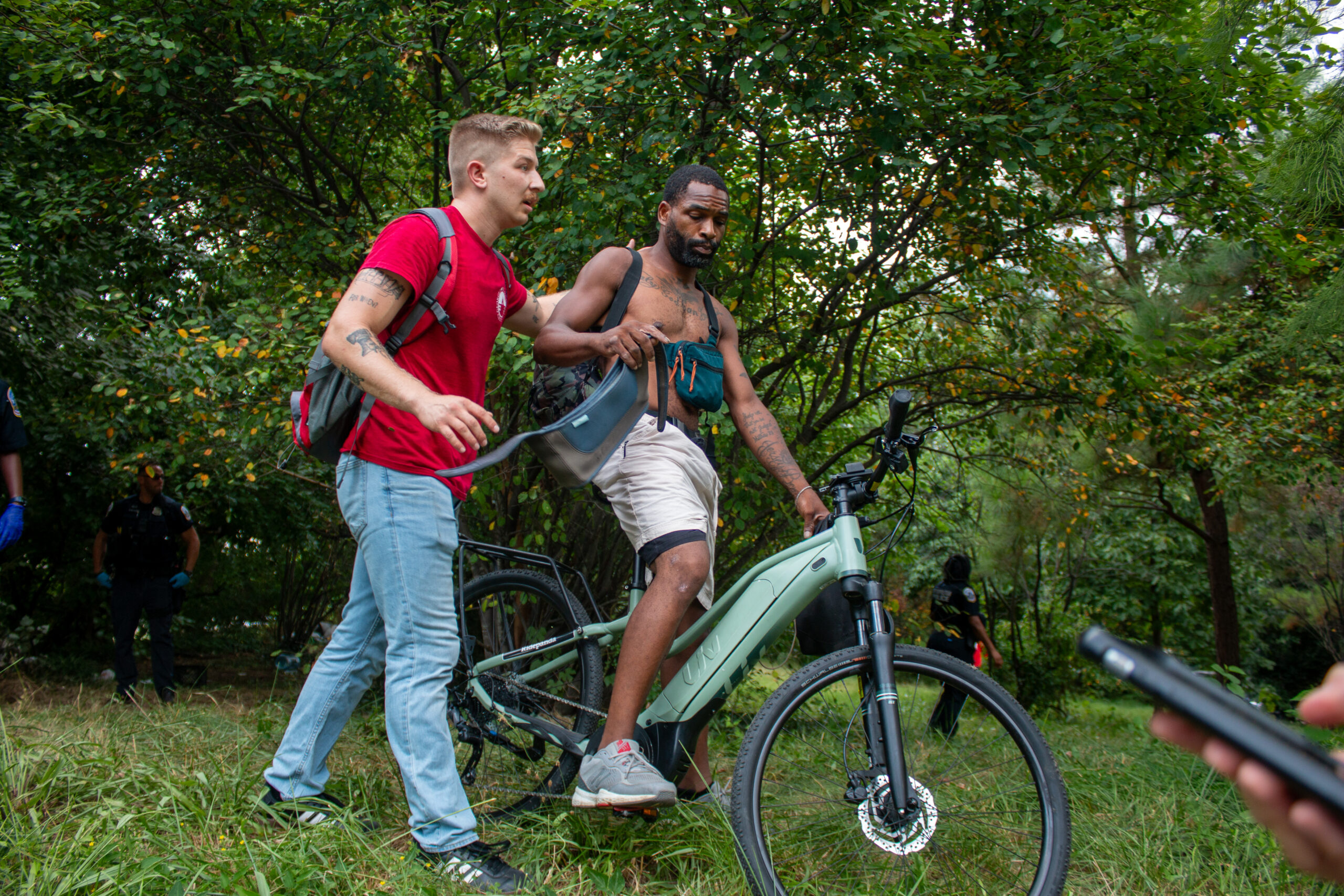
This article collection from Street Sense Media’s Encampment Updates Column (partially in collaboration with Slate Magazine) chronicles the effects of the federal takeover of the Metropolitan Police Department and President Donald Trump on people experiencing homelessness. Madi Koesler was the lead photographer and a core part of the reporting team throughout the takeover along with Franziska Wild and Annemarie Cuccia.
Additionally, pieces of this collection were awarded the DC Society of Professional Journalists 2026 Dateline Awards for Excellence in Local Journalism for the Beat Reporting and Breaking News categories.
Homeless residents react to Donald Trump’s threats to clear encampments in D.C.
Homeless residents react to Donald Trump’s threats to clear encampments in D.C.
Published Aug. 11, 2025 || By Madi Koesler
Franzi Wild contributed reporting.
With D.C.’s Metropolitan Police Department (MPD) now under federal control and the National Guard coming to D.C., the fate of people living in encampments remains up in the air.
During this morning’s press conference, President Donald Trump said law enforcement has already begun to clear encampments, but Street Sense has been unable to confirm this, and has not seen any encampments removed as of Monday afternoon.
Homelessness outreach providers and the Department of Human Services (DHS) visited encampments along I-66 before the Monday press conference to offer shelter and resources. DHS officials on site told residents, “from our perspective, we just want to make sure people are staying safe.”
This follows a Truth social post by Trump yesterday with photos of tents along the interstate and of one person on the steps of the American Institute of Pharmacy on his way to golf.
Street Sense reporters spoke to residents who live in the encampments along I-66 about their reactions to Trump’s announcement and threat to remove encampments.
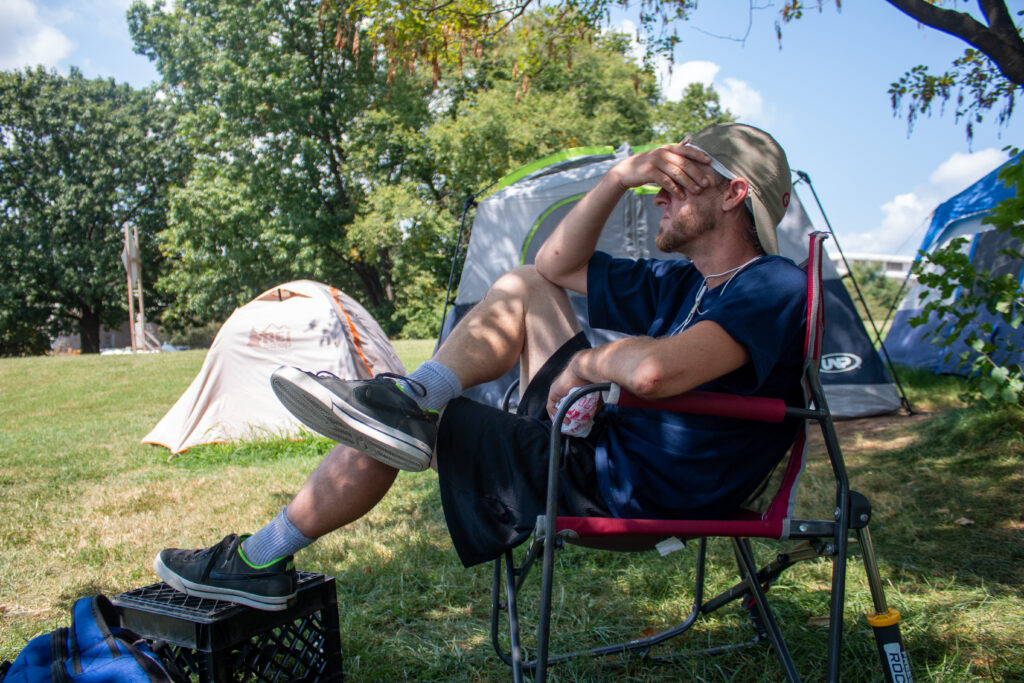
“I ain’t ever bought no prostitutes. I ain’t never raped nobody. I ain’t never paid anybody off. None of that stuff,” said G, a resident from one of the photographed tents.
“He’s much more of a criminal than I am.”
G says the worst thing he does is drugs, and he would willingly go to jail if Trump went with him. He moved to the green along the interstate because it felt safer than his apartment building. He’s found a community in his encampment over the last two months, but plans to move on Monday because of the attention from Trump and media outlets.
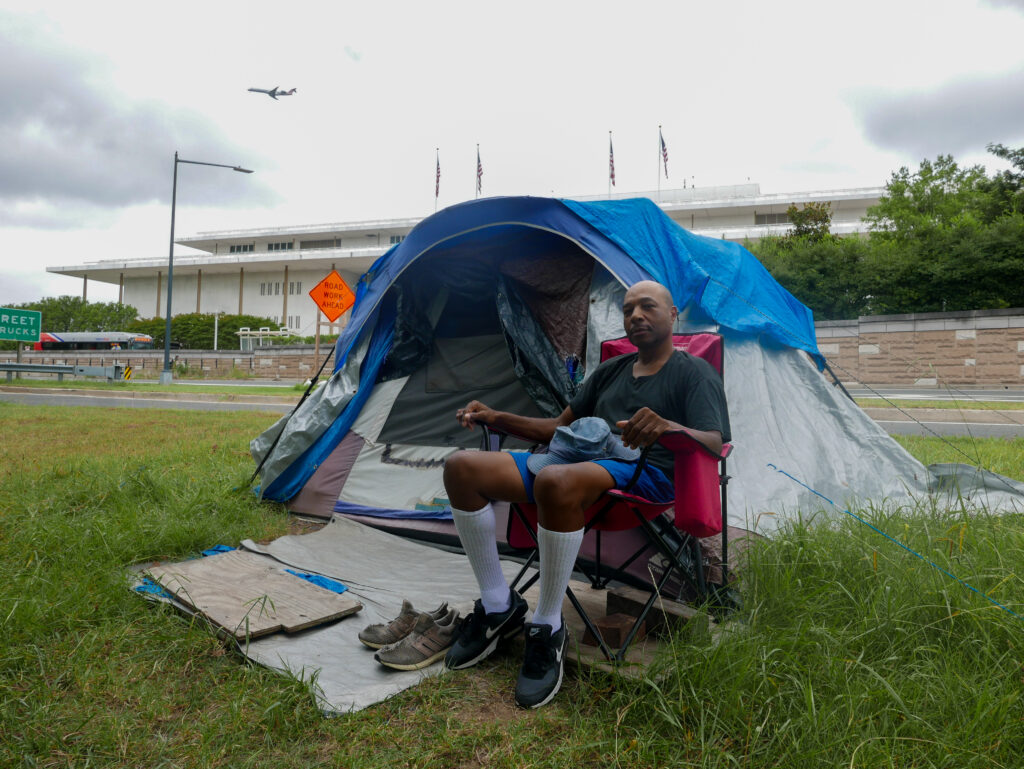
“They’ve been doing this to Black men since the dawn,” Franklin Lee said.
“He don’t give a damn. He’s saying fuck the Constitution.”
Franklin Lee’s lived outside for 10 years all across D.C. He currently lives in a tent along I-66 outside the Kennedy Center. Over the decade, he’s developed a distrust for law enforcement and Trump – feeling let down by how the government treats people who aren’t “billionaires and trillionaires.”
Lee doesn’t identify with either political party but says Trump is the first president he’s ever wanted to give the finger to before. If he is forced to move his tent, he said he plans to give the government a piece of his mind.
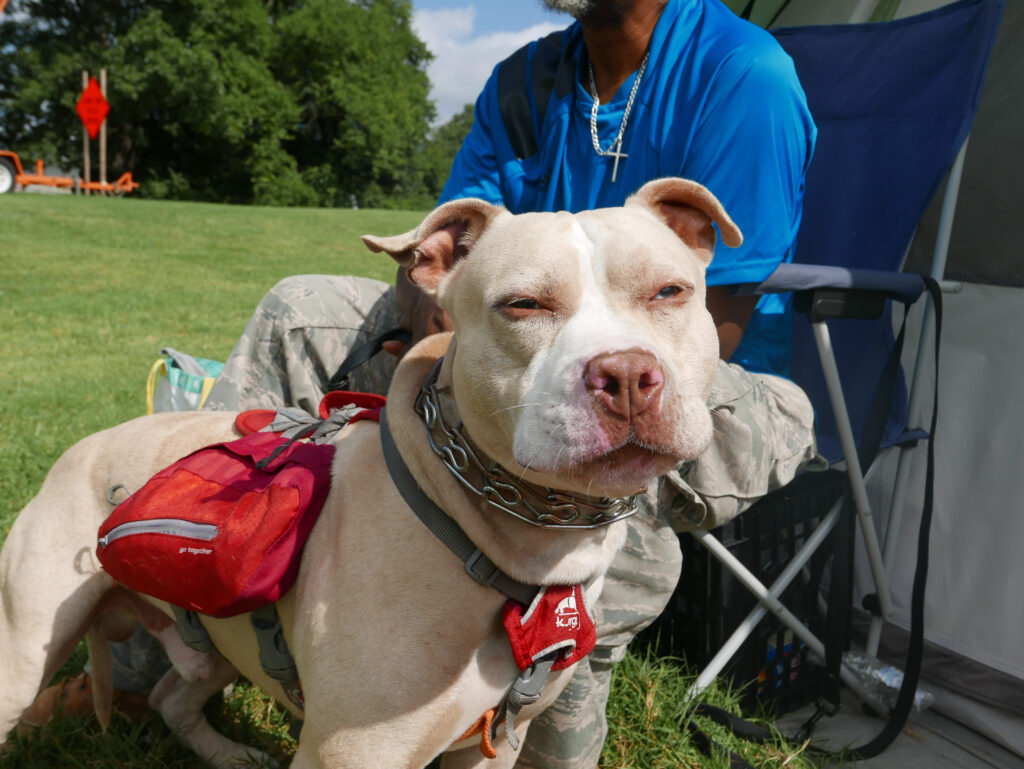
“I pray for America and the presidency on a daily basis. I pray for peace,” George Morgan said.
“I believe there’s a lot that could be done.”
Morgan also lives in one of the tents posted by Trump in the Truth social post along his commute to Trump’s National Golf Club in Sterling, Virginia. Morgan’s from D.C. and lived along the interstate for about two months with his dog Blue.
He is interested in moving into shelter, but doesn’t want to leave Blue behind. As he stays at his encampment, Morgan is optimistic that Mayor Muriel Bowser might be able to come to an agreement with Trump.
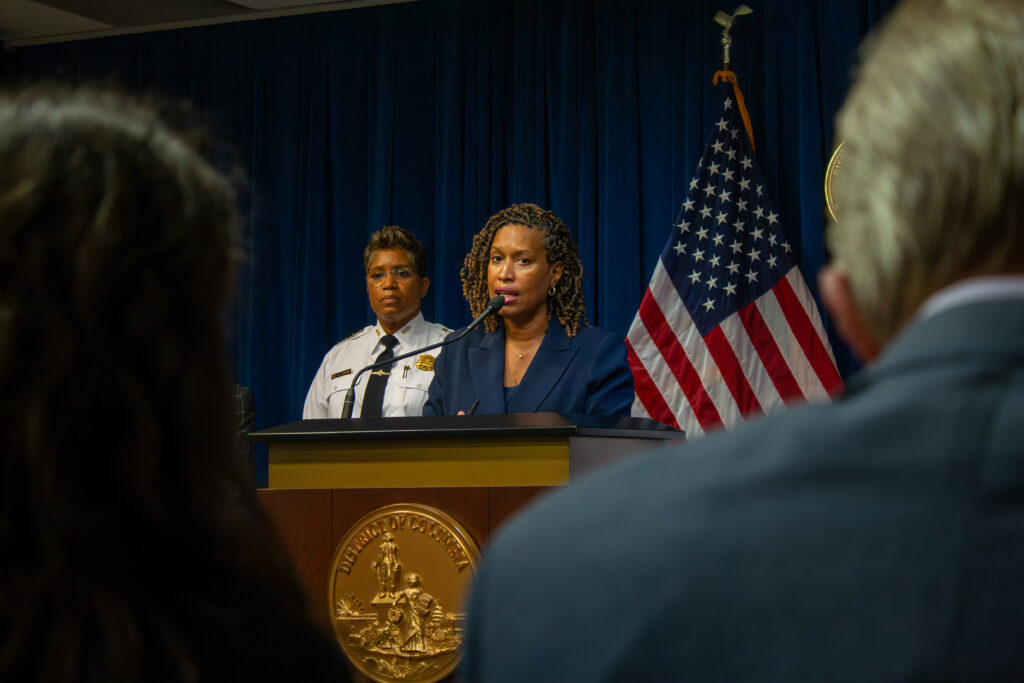
Bowser addressed the press just after 3 p.m. Monday, telling District residents the MPD will comply with the law but noted that D.C. has not experienced a crime spike since 2023. She confirmed she contacted Attorney General Pam Bondi, who was tapped by Trump to “take command” of MPD.
The mayor also noted that all law enforcement must be identifiable by a “uniform, a badge, a jacket, so that people know that they are law enforcement.” This comes after U.S. Immigration and Customs Enforcement (ICE) agents have been seen across the nation wearing masks and unidentifiable clothing.
When asked specifically about encampment clearings and if Chief Pamela Smith will comply if Bondi directs local law enforcement to arrest or move people experiencing homelessness out of D.C., Bowser replied, “Well, let me just say what MPD needs to be focused on, and it’s violent crime. We simply – like – our force, when the chief deploys, every day and every night, is focused on people who are committing crimes in the District.”
“We’re just trying to live:” The first two weeks of Trump’s crackdown on visible homelessness in D.C.
Published Aug. 27, 2025 || By Annemarie Cuccia and Franziska Wild
Madi Koesler, Katherine Wilkison, Mackenzie Konjoyan, Nina Calves, and Jelina Liu contributed reporting.
In a move that sent shockwaves through city residents, particularly those experiencing homelessness and service providers, President Donald Trump federalized D.C.’s Metropolitan Police Department (MPD) and deployed the National Guard to D.C. on Aug. 11.
In his announcement, Trump, who has frequently linked crime and homelessness, framed unsheltered homelessness and encampments as part of the city’s alleged crime problem. He directed law enforcement to remove tents and threatened to remove people experiencing homelessness from the city.
Over the following days, homelessness outreach workers scrambled to help people find safe places to sleep, putting them up in hotels or moving them into shelters, while fear, uncertainty, and frustration grew.
“You’re breaking people’s lives, and dreams, and their livelihoods. You’re messing people’s livelihoods up,” Temitope Ibijemilusi, who often sleeps downtown, said after law enforcement made him move his belongings. “You’re causing more problems, causing more anxiety.”
In total, Street Sense has confirmed that at least 20 people have been displaced from eight encampments through federally driven closures. Law enforcement told many more people to move from public spaces where people experiencing homelessness often congregate. Closures have largely been led by law enforcement officers, rather than the city’s normal outreach teams.
Though White House Press Secretary Karoline Leavitt said 48 encampments have been closed since Aug. 11, Street Sense has not been able to confirm closures at more than eight unique sites across the District. The White House did not provide a list of closed sites or sites it intends to close.
Data from the city, meanwhile, suggests the number of people living in encampments did not meaningfully decreased over the last two weeks.
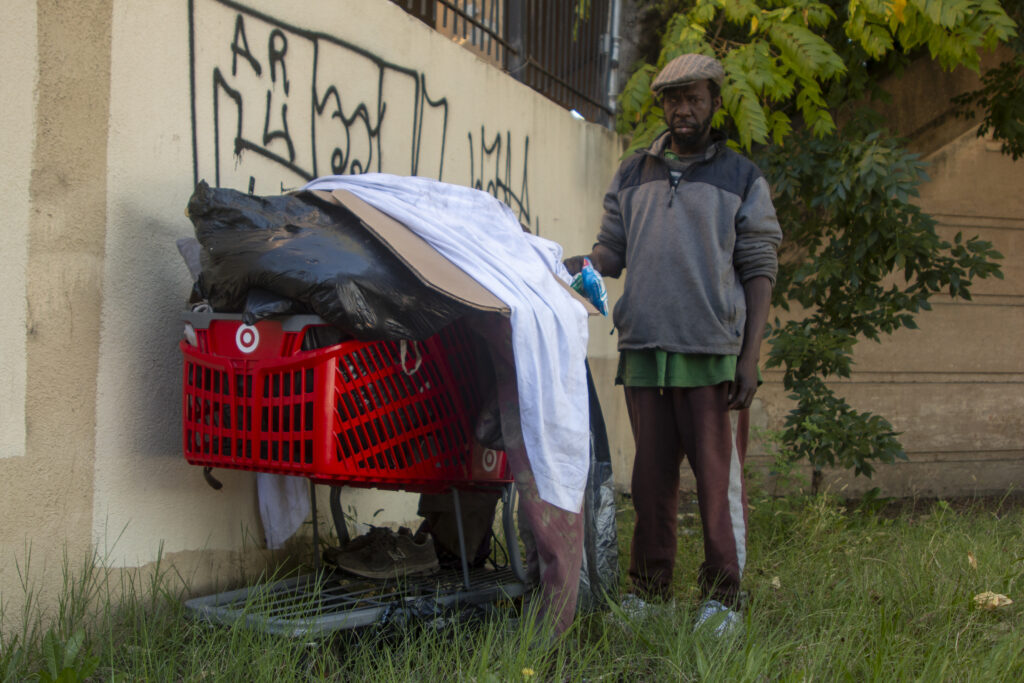
Meanwhile, dozens of people living outside reported harassment, fear, or uncertainty stemming from federal actions and rhetoric. Though the Trump administration threatened the criminalization of camping, panhandling, or sleeping outside, publicly available local arrest data and data provided by the White House do not yet show any arrests with those charges.
In response to the crackdown, the city opened more than 100 additional shelter beds, according to the D.C. Department of Human Services (DHS), and is prepared to open more if needed. A second noncongregate shelter will open in the next few months, providing additional beds, and the city will put more money towards its homelessness diversion program.
But not everyone feels safe going into shelters — Kevin, who sleeps outside the Martin Luther King Jr. Memorial Library downtown, said he finds the facilities overcrowded, and he worries about getting sick. So instead, he sleeps outside. These days, he feels particularly vulnerable to law enforcement.
“We already know what’s going on,” Kevin told Street Sense on Aug. 19, sitting outside MLK as the sun set. “I don’t know when, sooner or later, but they gonna come. They gonna come.”
The flashpoint
On the night of Aug. 14, faced with FBI agents and a swarm of press, Meghann Abraham decided she was going to stand in front of her tent, cross her arms, and face the onslaught. She knew she wasn’t doing anything wrong — no matter what the president of the United States might say.
“Being homeless is not a crime,” she told Street Sense a few hours before. “We’re not drug addicts. We’re not criminals. We don’t have guns or nothing. We’re just trying to live.”
Abraham, who’s 34 years old, recently earned an associate’s degree from the College of Southern Maryland in the applied science of Homeland Security. She’d like to work for FEMA someday, helping people in crisis. After moving from the MLK Library, she lived with her boyfriend in a tent on the edge of Washington Circle for the past couple of months.
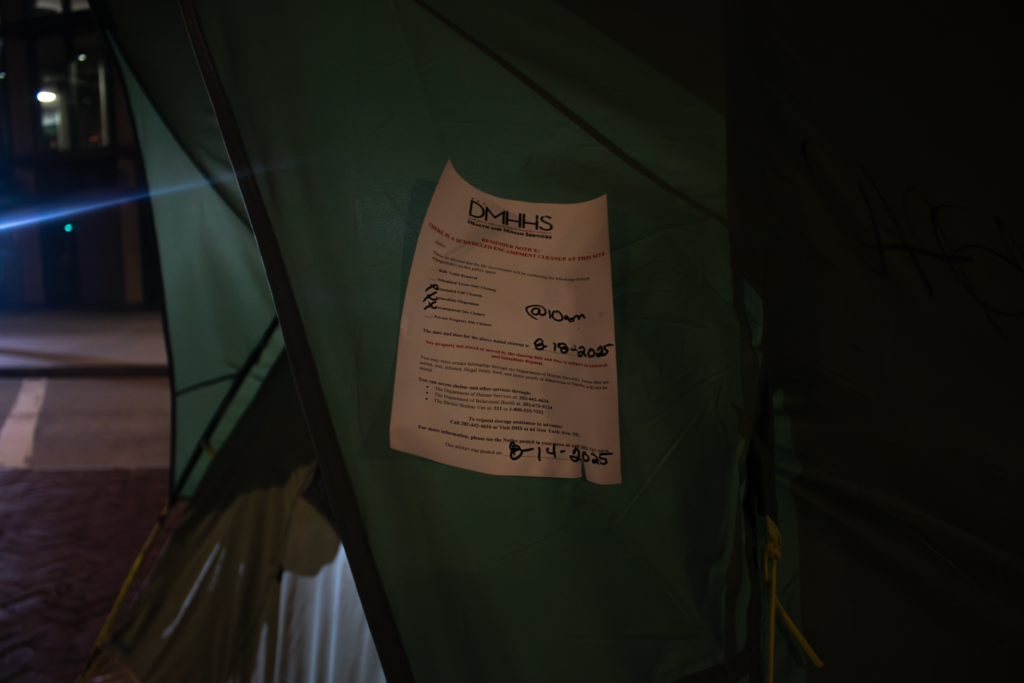
On Aug. 14, whispers began federal agents would start closing D.C.’s encampments. Late that afternoon, the city placed stickers on several tents in Washington Circle, notifying residents the encampment would be closed four days later, on Aug. 18. At the time, outreach workers and local officials said they did not know what locations federal agents would be targeting. They learned the plans only shortly before the FBI arrived.
Just after 9 p.m., at least 12 FBI agents arrived at Washington Circle, intending to remove several tents, including Abraham’s.
When agents approached Abraham, she showed them the sticker from the city. With the support of legal advocates, she argued she had the right to stay until Aug. 18. Agents eventually left, and though they returned once more, they were seemingly deterred by the sticker. That night, they closed neither Abraham’s encampment nor the four nearby ones they told city officials they’d be visiting.
But the FBI agents’ departure that night was a brief reprieve. Local law enforcement returned to Abraham’s encampment, as well as several others, on the next morning, closing them on the orders of the federal government.
Officers were first spotted near the city’s Downtown Day Services Center, where many people experiencing homelessness go to get meals, showers, IDs, and other assistance. Residents and outreach workers said officers threw away some of the belongings of people in the area. Staff for nearby programs tried to keep people inside to make sure they stayed safe, accompanying clients outside to keep watch on them during their smoke breaks.
Ibijemilusi just recently began living outside the center, after the person he had been staying with passed away. He told Street Sense that law enforcement told him to break down his tent and discarded some other people’s possessions.
“A lot of people lost their things today,” Ibijemilusi said.
MPD then went to the tents near Washington Circle and told Abraham she had to move or risk arrest. Her boyfriend was at work at the time. MPD also threw away the tents and belongings of other encampment residents, even as Abraham scrambled to get in touch with them.
“They were [asking] is this trash? Is this trash? And I was, like, none of my stuff is trash. I have all these things because I want to own them,” Abraham told Street Sense reporters who arrived as the forced displacement was underway. “But then it’s me trying to advocate for myself against 20 police officers.”
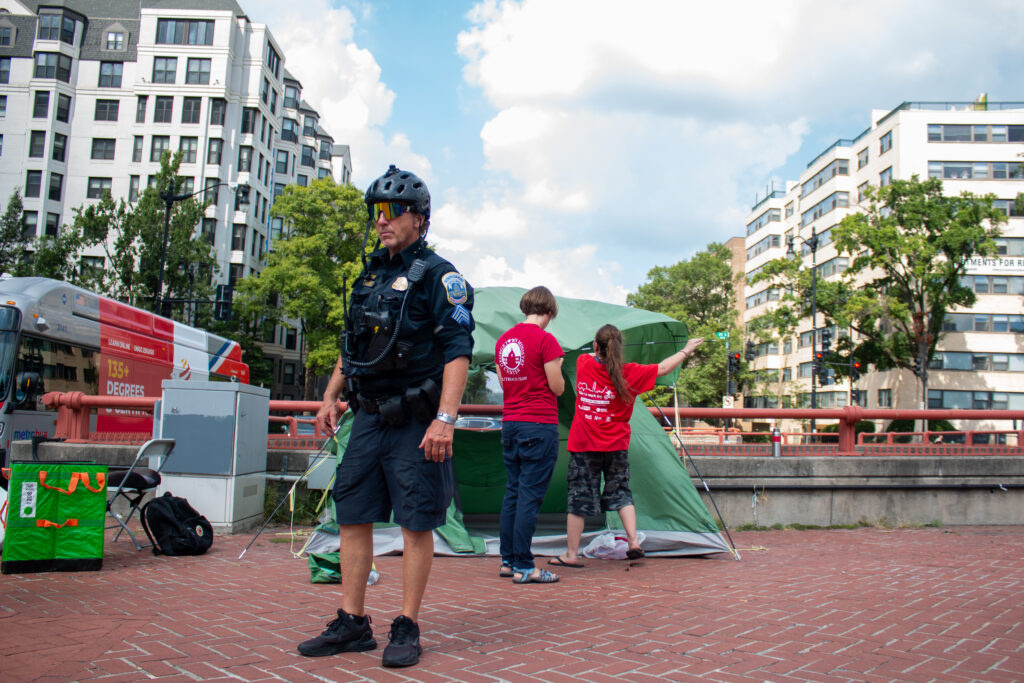
MPD then headed down the street to 26th and L, where officers removed three tents, displacing at least one resident. Next, MPD officers headed downtown to a structure near 15th and G Streets and removed the structure. It did not appear that a resident was present.
In total, officers cleared at least 11 tents on Aug. 15 — most thrown into a Department of Public Works truck that accompanied law enforcement. The effort was led and conducted by MPD, rather than federal law enforcement. The Office of the Deputy Mayor for Health and Human Services (DMHHS), which normally runs encampment closures and clearings in the city, was not involved in the closures, according to a statement from the agency. Street Sense also did not observe the usual presence of city social support agencies at any of these closures, other than two DHS officials at 15th and G Street.
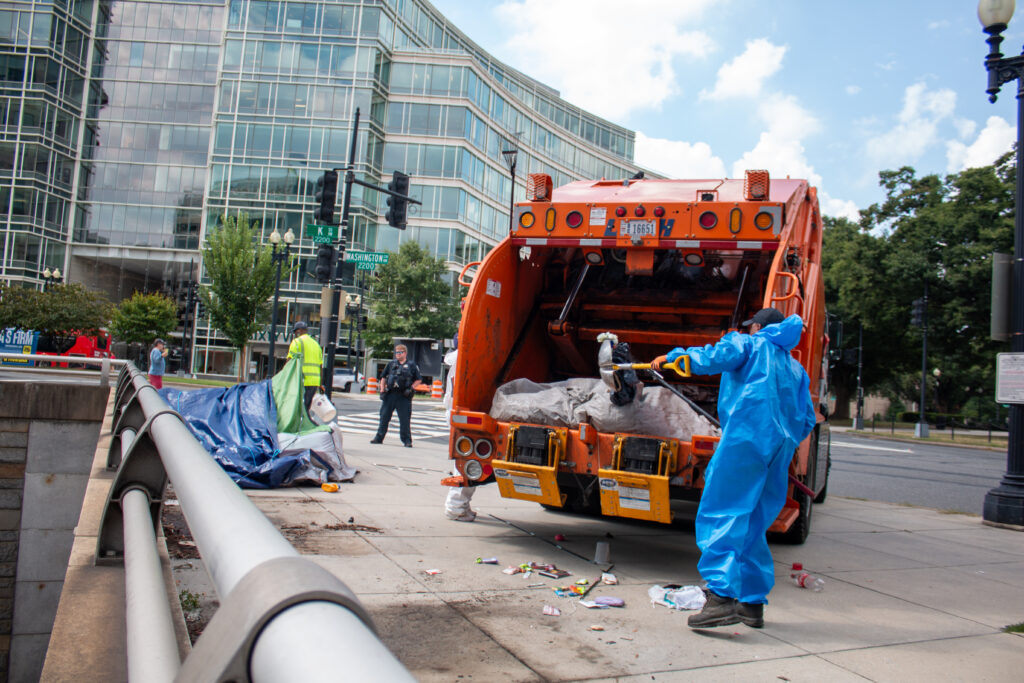
“The District had a scheduled engagement to close the site at Washington Circle on August 18,” a DMHHS spokesperson wrote that afternoon. “However, today, federal officials chose to execute the closure at the site and several others.”
Jim Malec, an ANC commissioner for the area, said he was angry MPD closed the encampment early, and concerned about the city government’s possible compliance with Trump’s directives.
“To promise these people a Monday deadline and then destroy their property three days early is simply cruel, and we must ensure that whomever is responsible for this decision is held accountable,” Malec wrote in a statement to Street Sense.
When Street Sense called Abraham a few days later and asked her about the closure, she described the experience as “violating.”
The most recent federally driven encampment closure Street Sense identified was on Aug. 18, when MPD officers again visited the area by the city’s Downtown Day Service Center. Officers stood outside the center for about an hour as outreach workers and day center staff helped people leave the area. Despite fears that U.S. Marshals would be on the scene, the engagement was conducted by local police and DMHHS.
A DMHHS official on site told Street Sense the clearing was a “White House-mandated engagement.”
One man, who gave his name as Willie Nelson, said he was waiting outside the center in hopes of getting an ID. The center distributes IDs only on Thursdays, and has a limited number each week, so Nelson said he was sleeping nearby until then, hoping to beat the rush.
“I’ll be the first in line,” he said.
The state of encampments
D.C. is made up of a mix of local and federal land. Under normal circumstances, those boundaries dictate if encampments are closed and which authorities lead the closure.
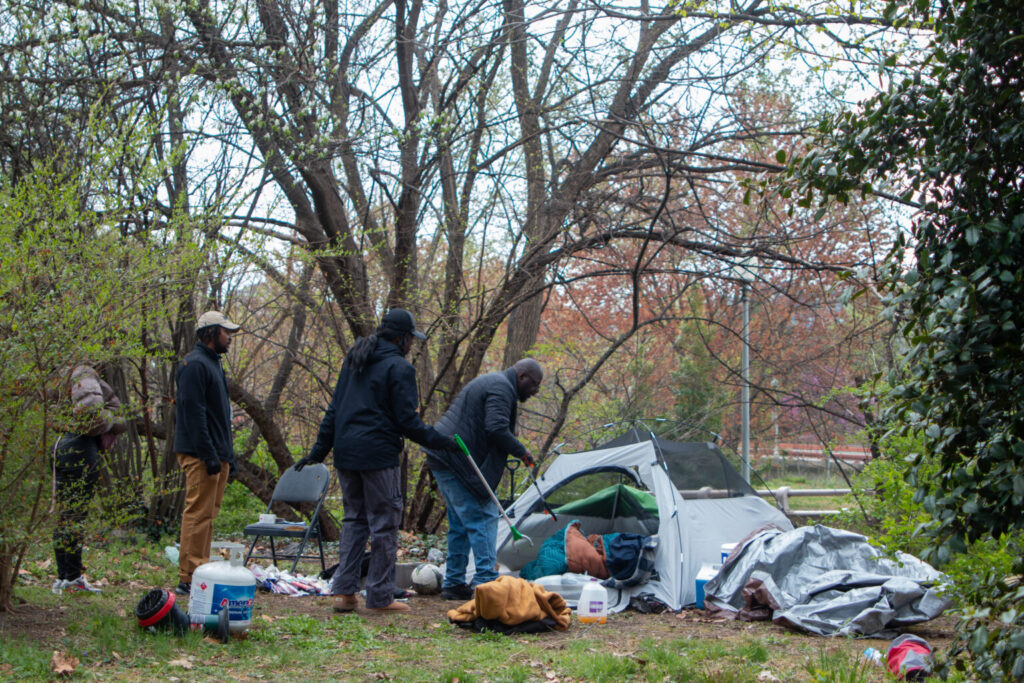
Encampments on federal land, such as the C&O Canal, Rock Creek Park, and green space near monuments and federal buildings, are cleared at the discretion of the National Park Service (NPS). NPS and its associated law enforcement, Park Police, began reinforcing camping bans in May 2024. They accelerated in March, after Trump issued an executive order to “make the District of Columbia safe and beautiful.”
Between March and early August, the agency cleared 70 encampments, Secretary of the Interior Doug Burgum said at an Aug. 11 press conference. At the start of the federalization, two encampments remained on federal land, Leavitt said at an Aug. 12 press conference.
The city has its own process to respond to encampments on local land, using a team from DMHHS to track, conduct outreach with, and sometimes close encampments. The city has closed at least 60 encampments since the beginning of the year, according to data compiled by Street Sense. According to DMHHS, as of the start of Trump’s takeover, there were 62 encampments in the city. About 100 people lived in them, though far more people sleep outside on any given night; at least 800, according to the most recent count.
Trump’s federalization upended the normal encampment process. His oversight of the local police (which, even when limited, means the federal government has discretion over how police interact with encampments) turned MPD officers into encampment teams as part of his bid to remove the “drugged-out maniacs and homeless people” he says have taken over the city.
“This is his issue, seeing homeless encampments — it just triggers something in him,” Mayor Muriel Bowser said in a live community chat streamed on X Aug. 12.
The city was the first to begin unscheduled and expedited encampment closures, visiting spots near the Kennedy Center on Aug. 13 to inform residents they should move their tents over the next day. (Trump was at the Kennedy Center the same day.)
On Aug. 14, the city closed the encampment that had initially drawn Trump’s ire in a Truth Social post, in which he accompanied photos of tents along the interstate with the sentiment “The Homeless have to move out, IMMEDIATELY.” Under D.C. protocol, the closure was an immediate disposition, an encampment closure in which residents only have 24 hours’ notice as opposed to the standard 7 days’, making this closure comparably hurried.
Rachel Pierre, the interim head of DHS, said the closure was a response to the August executive order and that other sites could be closed in the coming days. Deputy Mayor for Health and Human Services Wayne Turnage and other city officials suggested the city was more qualified to close encampments. While trying to stay ahead of federal closures, officials emphasized they had more services to offer residents.
“Closing encampments is a very, very complex process, you are dealing with human beings who, in many cases, have been marginalized, their lives are being disrupted,” Turnage told reporters on Aug. 14. “We felt that if the site was going to be closed, because it was a sizable site, we should do it ourselves,” he said, referring to the seven tent encampment along the interstate.
City outreach workers had been in the area since Trump’s Truth Social post, working with encampment residents, who were on high alert if they had not already moved. One man, G, told Street Sense on Aug. 11 that he was planning to move that day because of the attention the encampment began receiving.
Another, George Morgan, said he was hopeful Trump and Bowser could come to an agreement. He said he was interested in moving into one of the shelter spots the city had recently opened. But to do so, he would have to leave behind Blue, his beloved dog; the city’s shelters don’t accept pets.
Despite Morgan’s hopes, the Aug. 14 closure went forward. At least one resident accepted an offer to move into shelter, and outreach workers offered phones, storage, and hotel rooms to other residents.
As the city began the closure, about 12 protestors arrived, standing in the center of the encampment. Protestors held signs reading “being poor is not a crime” and “being unhoused is not a crime.”
One protestor, Reverend Ben Roberts, came from Foundry United Methodist Church, which helps low-income people and those experiencing homelessness navigate the ID application process.
“The only way that we end homelessness is to house people. If you’re housed, you are not homeless,” Roberts said, “So we need to put our resources and our leadership into making sure that that is what’s happening, versus this gigantic game of whack-a-mole that only prolongs the problem.”
This is a common refrain from advocates; while encampment closures can make homelessness less visible, they don’t directly move people into housing. While some people have moved into shelter in the last few weeks (though there is no specific number available), the closures have not been coupled with new federal resources to bring any of them closer to permanent housing.
Rather, many people seem to be shuffling around. David Beatty said he lived at the encampment near the interstate for about six months, moving there after another encampment closure. He and another resident were considering moving somewhere in Virginia, where he had lived before, but he was worried about the distance. He has tendonitis, he said, so it can be hard and painful to walk sometimes.
“I don’t know how far a walk that is,” Beatty said.
Where are people going?
In total, since Trump’s takeover began, Street Sense has recorded the removal of at least 20 tents and the displacement of at least 20 people in encampment clearings — though that number is probably much higher if clearings of people without tents are factored in.
According to DMHHS, after two weeks of federalization, there were still 68 encampments in the city, with just over 100 residents. The numbers, which are strikingly similar to what the agency reported on Aug. 11, suggest that rather than moving into housing or shelter, most people are just moving around, likely to harder-to-reach places.
There has been a slight uptick in people accepting shelter, according to street outreach workers and the people experiencing homelessness Street Sense has surveyed, but the city did not provide numbers to confirm how many more people have entered shelter in recent weeks. Some people have also temporarily moved into hotels with the help of community groups, though they may not be able to stay long due to limited resources.
Street Sense has also spoken with a couple of people who have chosen to move to either Virginia or Maryland. Last week, local officials in neighboring jurisdictions said they worried about seeing an influx of people if they fled D.C.
Thus far, Hilary Chapman, the housing program manager at the Metropolitan Washington Council of Governments, which coordinates the local Point-In-Time Count, said surrounding jurisdictions haven’t seen a significant increase in people experiencing homelessness, though it could be too soon to tell.
Rather than leave, street outreach providers say most of their clients have chosen to seek new and more hidden spots to spend their time.
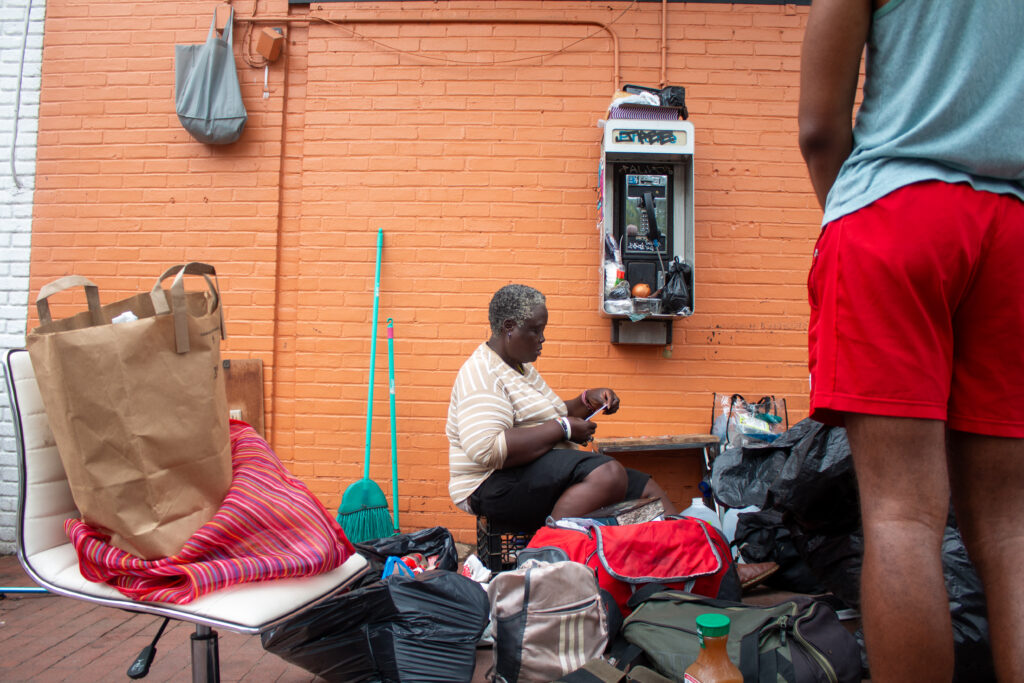
Edward Wycliff, director of strategic partnerships and community navigation at District Bridges, said his organization’s teams typically see between five and 20 clients in a single outreach session. Now, it’s down to one or two.
“There are people making themselves scarce,” Wycliff said. It’s been harder for outreach workers to find clients in the last few weeks, he said, which also makes it harder for people to access resources.
His experience aligns with the informal surveys Street Sense reporters have conducted with people experiencing homelessness. After speaking with nearly 70 people over the last two weeks, Street Sense found most people said they tried to avoid attracting the attention of law enforcement as much as possible. People listed a variety of tactics, including avoiding sleeping in exposed places, walking around at night instead of sleeping, and spending more time at drop-in centers. They also said they tried to “act stiffer” or not draw attention to themselves when they see officers patrolling.
“They are responding to this moment with this oppressive situation where people are hunting for you,” Wycliff said. “It makes it hard for the person who is looking for you for something supportive to try to locate you.”
Fear on the streets
Since the announcement, there’s been an air of fear among advocates, outreach staff, and people sleeping outside about whether this would be a turning point in D.C.’s criminalization of homelessness. While camping, aggressive panhandling, and other actions are currently illegal in D.C., MPD generally does not make arrests for these offenses, though some encampment residents have been arrested at federal closures or involuntarily hospitalized.
In a press conference on Aug. 12, Leavitt said MPD would begin reinforcing laws against camping, and people experiencing homelessness “will be given the option to leave their encampment, to be taken to a homeless shelter, to be offered addiction or mental health services,” and if they refuse, could be fined or arrested.
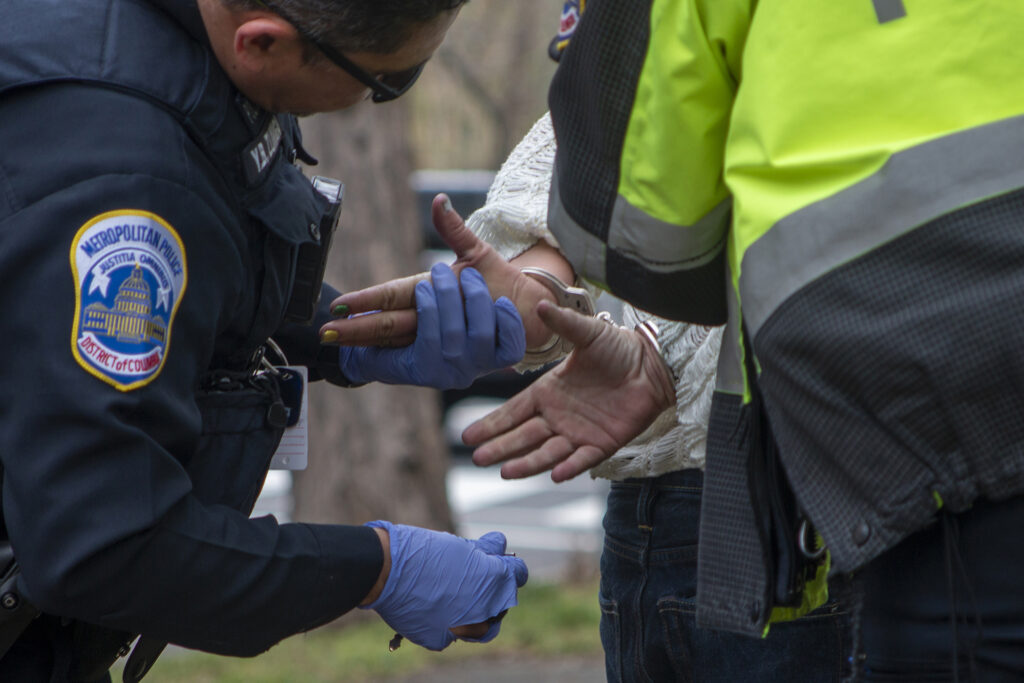
According to a White House official and public local and federal arrest reports, law enforcement has not made any arrests for homelessness. Street Sense has also not been able to identify any arrests. But, the official said, MPD will begin enforcing local laws against being in public spaces soon. These local laws include D.C. Code 22-1307, which prohibits individuals from crowding or obstructing streets, sidewalks, building entrances, or other passageways, and D.C. Municipal Regulation 24-100, which prohibits the unauthorized use of public space.
It’s unclear how the general surge in law enforcement has impacted people experiencing homelessness, who may be more vulnerable to being charged with some crimes. At least five people who are experiencing homelessness have been arrested since Aug. 11, but all on charges not explicitly related to homelessness.
For instance, law enforcement has emphasized arrests for “quality of life crimes,” which include things like consuming alcohol or marijuana in public. These kinds of arrests disproportionately target people experiencing homelessness because, by definition, the offense must take place in public, which is where people experiencing homelessness spend more of their time.
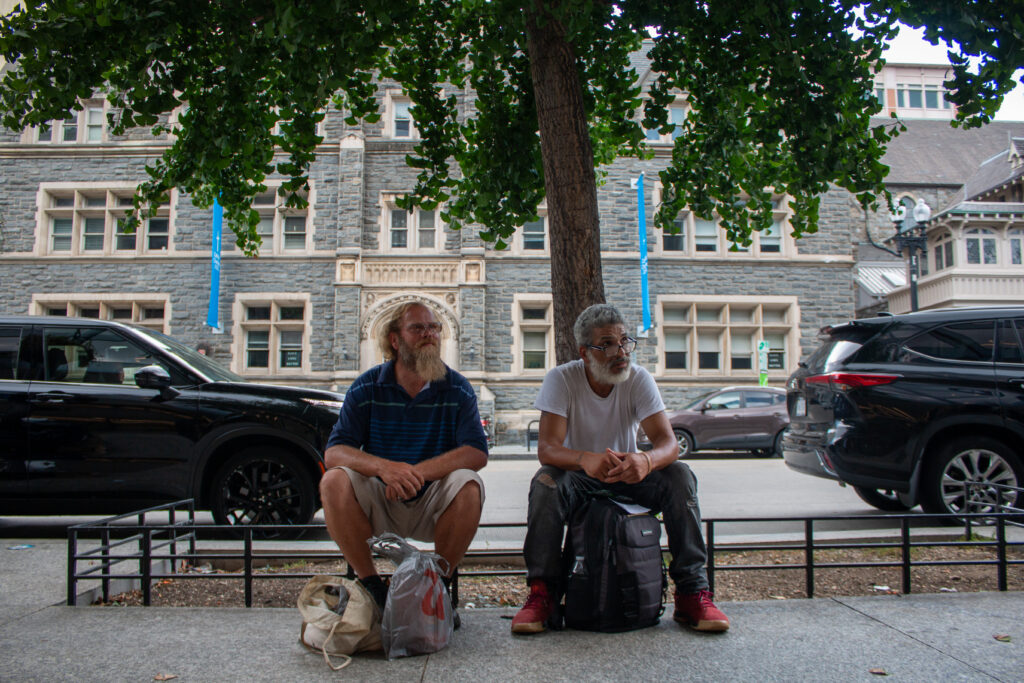
The D.C. Hospital Association has also not reported a spike in involuntary hospitalizations as of Aug. 20. In the lead-up to the takeover, the Office of the DC Attorney General emailed area hospitals warning them of a spike in involuntary hospitalizations as federal agents fanned out into the city.
Of the over 70 people Street Sense reporters have surveyed in the last two weeks, law enforcement interactions have been inconsistent. Many people did not report increased interactions with law enforcement, but others were asked to show ID or told to move.
For example, Street Sense spoke with a pair of friends who said early on Aug. 13, Secret Service agents woke them and told them they could no longer sleep in Franklin Park. Another man said his friend, who regularly panhandles on a busy street, has been missing since the takeover began.
In some areas where people often sleep, like outside MLK Library, fewer people have congregated over the last few weeks. Some people outside the library, though, seemed relatively unconcerned. Several people said they think officers will focus on violent crimes, and not on people sleeping outside.
Robert Hulshizre said more outreach workers had been by than police. “They already know who’s here; it’s not as if we hide and seek.”
Outreach workers worry about the long-term impacts of the crackdown, which may disconnect people from their service providers and create distrust that will make it harder to ultimately move people into housing.
”For the clients that I can find, or that we can find, the attitude is driven by fear,” Wycliff said. “They’re hearing of and witnessing people in the community or random people on the street being arrested, it’s scary for a lot of clients, it’s scary for a lot of outreach workers.”
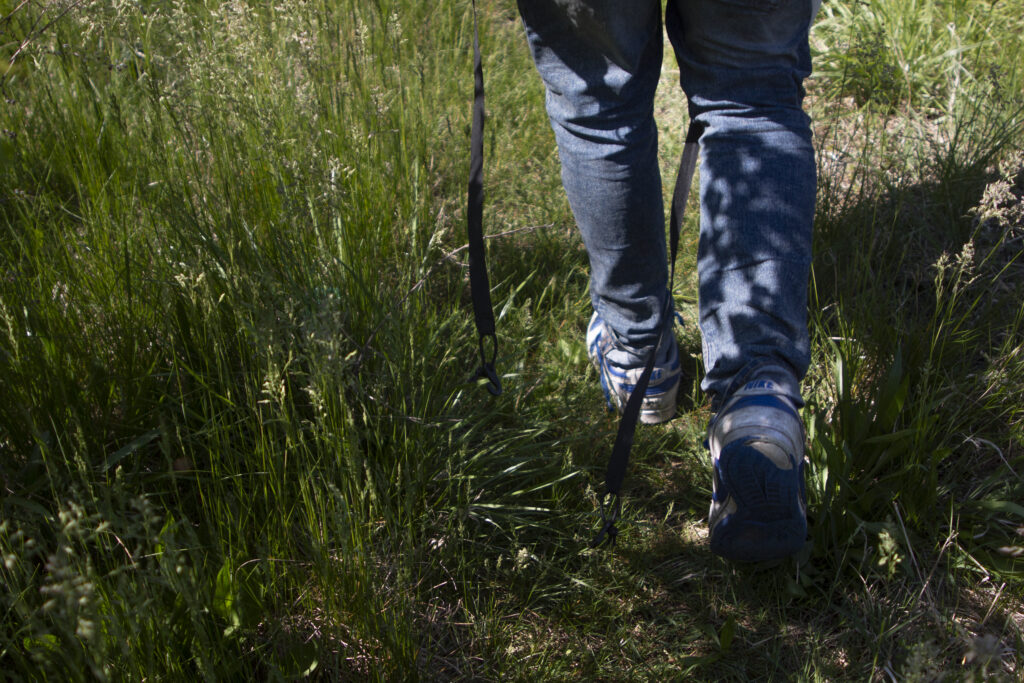
For the people most impacted by Trump’s actions, there is a deep understanding of how ineffective they are at addressing the problem. Most have chosen to move to new spots in D.C. Even people who have accepted shelter are not significantly closer to permanent housing.
Abraham decided to move elsewhere in the city because shelter doesn’t work for her, she said. But when asked what she would say to the president — who ordered her forced displacement and equated people like her with criminals — she underscored the futility of his approach.
“In D.C., being homeless is not a crime,” she said. “They need to provide us another option, and they’re not doing that, they’re just saying get out of here.”
Homeless people scatter after recent federal and local encampment closures, but many are still living outside
Published Sept. 10, 2025 || By Annemarie Cuccia, Madi Koesler, and Franziska Wild
Mackenzie Konjoyan and Katherine Wilkison contributed reporting.
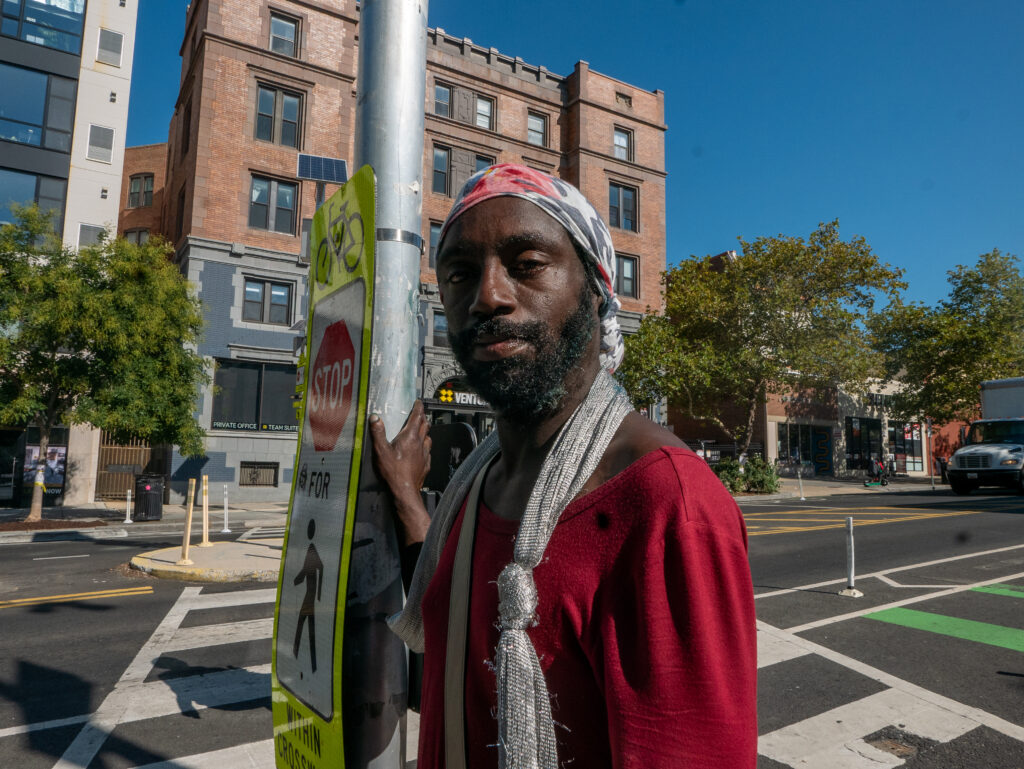
Three weeks into the federal government’s crackdown on visible homelessness and crime in D.C., an impromptu count of people experiencing homelessness found hundreds of people are still living outside in the District.
Combined local and federal efforts closed at least 50 encampments in August, according to the White House, though Street Sense has only confirmed 24 closures since the surge began on Aug. 11. (The White House has not provided a list of closed encampments, or responded to questions about why it could not provide such a list.)
But even as President Donald Trump claimed victory for his efforts, a census of people sleeping outside conducted by the D.C. Department of Human Services (DHS) suggests unsheltered homelessness in the city did not meaningfully decrease due to the encampment closures, which advocates argue do more to move people around than to move them into housing.
Without a doubt, the federal crackdown decreased the number of visible encampments in the District. The count found 54 tents across the city, compared to 107 at the end of July. And the human impact has been clear. People living both at encampments closed by law enforcement and the city’s encampment team have scattered, often losing possessions and community in the process. Some “rough sleepers,” people who sleep outside but not in a tent, have made it a point to avoid law enforcement.
But it’s harder to tell if the crackdown has impacted the number of people experiencing unsheltered homelessness overall. While about 80 new people went into shelter in August, according to the city, at least 764 were still sleeping outside each night, according to the census. This is just 30 people fewer than the annual Point-in-Time (PIT) Count found were sleeping outside in January, though the city cautions against directly comparing the two numbers due to differing methodologies. These numbers don’t include people who are homeless but sleeping in shelters; the January PIT Count recorded a total of over 5,100 people experiencing homelessness in the District.
Meanwhile, the city has scheduled several encampment closures through September, including at encampments that have not been closed recently. The city has closed at least 16 encampments in the last two weeks. While this is an uptick in local encampment closures compared to the summer, it’s not unprecedented, as the city averaged three to four encampment closures a week as recently as this spring.
“We have a relatively small encampment problem in D.C.,” Mayor Muriel Bowser said at an Aug. 27 update on the federal crackdown. “However, it is highly visible.”
The new state of homelessness in D.C.
Shelters, across state lines, friends’ couches — where have people gone since Trump threatened the widespread removal of people experiencing homelessness in the district?
Surveys by Street Sense confirmed that while some people impacted by encampment closures are considering shelter, most stayed outside, either in new spots or without tents. A few crossed state lines into Virginia or Maryland. With the help of mutual aid groups, some residents in special circumstances temporarily moved into hotel rooms. But the question of “where are people going?” is still heavy on the shoulders of D.C.’s unhoused population and outreach workers.
“There has been a significant disruption in the lives of people who live unsheltered,” Deputy Mayor for Health and Human Services Wayne Turnage said ahead of the unsheltered count.
When encampments are closed, people move, and if they don’t have reliable phone service or lose their phone in the closure, they can lose touch with outreach workers. Andy Wassenich, the director of policy at local outreach and housing nonprofit Miriam’s Kitchen, said his team has lost contact with at least 25 people since the takeover began.
Christine Hong, the chief of services to end and prevent homelessness, at the Department of Human Services in Montgomery County, Maryland, said the county has been closely monitoring the data it receives from street outreach and emergency shelters since the White House announced the federal surge. So far, the county has not seen a significant influx of new people, Hong said. But anecdotally, outreach workers and county residents are seeing “new faces,” including people who won’t share their names or where they’re from, which could indicate they’ve recently moved from the District.
“Whenever you clear encampments and the residents do not accept the offer of shelter that you make, they will tend to scatter, so that creates difficulty for our outreach team to relocate and continue the offer of homeless services,” Turnage said, explaining the homeless census was conducted to ensure the city could better provide outreach services to people experiencing homelessness.
The census somewhat mirrored the annual PIT Count, conducted every January, and attempted to determine where people were sleeping outside the night of Aug. 28, following the mass clearings.
During the census, DHS volunteers and outreach providers walked every block of the city between roughly 9 p.m. and 1 a.m. to count people they assumed to be experiencing homelessness. Counters didn’t individually survey people, meaning there is no confirmation that everyone counted is experiencing homelessness. Instead, volunteers cross-referenced recent data from outreach workers about where people often slept.
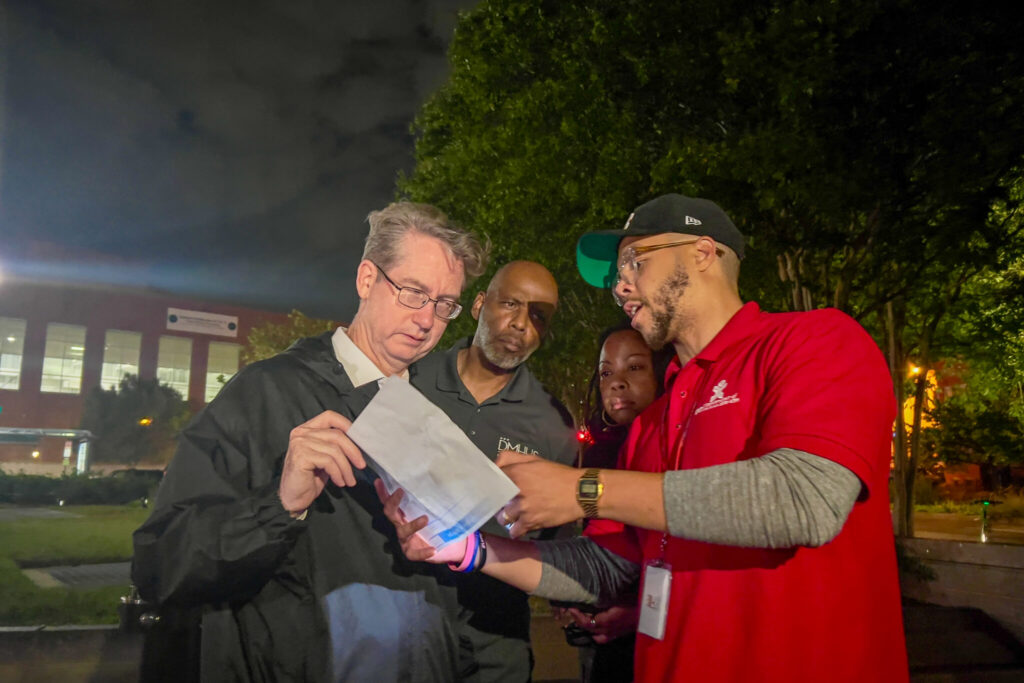
Because of the difference in methodology, the city cautioned against comparing this census to PIT Count data, though it is the most recent public data on unsheltered homelessness in the city. The Community Partnership for the Prevention of Homelessness’ PIT Count data reported 798 people sleeping outside in 2025, 900 in 2024, and 825 in 2023, just slightly above the 764 people found in August. The PIT itself is largely understood to be an undercount.
The census was the city’s idea, according to Turnage, and as of the night of the count, there’d been no discussion of sharing results with the federal government.
As winter approaches, the city plans to use data from this count to increase shelter beds, officials said. The city opened 100 new low-barrier shelter beds in early August. D.C. is actively working to increase homelessness services capacity by at least 300 more beds, Bowser announced in a press conference the same week of the census. This includes 190 beds at the new noncongregate facility on E Street set to open in September.
“We don’t expect that we’re gonna have homeless encampments, and we are gonna work to make sure people can come into shelter,” Bowser said at the conference on Aug. 27, ahead of the count.
More beds might sound like an ideal solution to move people inside, but many unsheltered people in D.C. prefer their encampments to the city’s shelters. Encampment residents feel like they have more privacy and autonomy when living outside or in tents than in shelters. Many shelters in the District have curfews, bag limits, and security checks. They also prohibit pets and are, for the most part, single gender, meaning couples and adult families may have to split up.
People living outside emphasize that shelters are not a home. Encampments can provide a sense of community and more freedom than shelters. Having a space that is all their own, even though it’s outside, provides a sense of privacy and ownership that the communal style of shelter living can strip away, even as it offers more protection from the elements.
“You have to cure the problem, not put a band-aid on the problem,” said one person experiencing homelessness, who asked to remain anonymous to protect their safety while living outside.
City-driven encampment closures
Encampment closures during the first week of the crackdown were mired in confusion, as law enforcement led many closures, and it seemed the city’s social service agencies and encampment team were not always aware of closures beforehand.
“When we first got started, it was a little difficult to try to figure out how it would work,” Turnage said on the night of the count.
But now, he said, the federal and local teams have worked out a protocol. The federal government can inform D.C. about sites it finds and ask to get a team there to close the site.
According to a White House official, MPD patrol units are also working to locate and close encampments. The White House is reporting a much higher number of encampments closed than the city, suggesting there have been several closures the city wasn’t at, or still doesn’t have information about.
“President Trump is cleaning up D.C. to make it safe for all residents and visitors while ensuring homeless individuals aren’t out on the streets putting themselves at risk or posing a risk to others. Homeless people will have the opportunity to be taken to a homeless shelter or receive addiction and mental health services,” Abigail Jackson, a White House spokesperson, wrote in response to questions about encampment closures.
Street Sense followed up, asking how the White House is able to ensure people are offered shelter or treatment if the relevant D.C. agencies aren’t aware of a closure. It also requested a list of sites closed by law enforcement at the behest of the White House without DMHHS involvement. White House officials did not provide specific responses to either question.
Since Aug. 18, the city has closed 16 encampments: three scheduled before the federal surge, four regularly scheduled local closures, six emergency closures, which the city calls immediate dispositions, and three federally mandated closures. None of the residents Street Sense was able to speak to at the closures moved into shelter.
The first federally mandated closure was on Aug. 18, outside the Downtown Day Services Center, where people go for meals and other resources. There was one more each of the next two weeks, on K Street downtown and outside the Martin Luther King Jr. Memorial Library, where people who sleep outside like to congregate. The closures were conducted by the city, but ordered by the federal government, according to a spokesperson from the Office of the Deputy Mayor for Health and Human Services (DMHHS), which oversees encampment closures. At least one person staying outside the library lost belongings during the closure, including a phone and other valuables, according to the resident, who emailed Street Sense after the closure.
Three immediate dispositions, near Washington Circle, the Arboretum, and a southwest overpass, took place the last week of August. Street Sense did not know about the closures ahead of time and cannot confirm how many people were affected. Another three immediate dispositions near Martin Luther King Jr Memorial Library, Eastern Market, and Federal Center during the first week of September displaced five people.
Three closures originally scheduled for the first week of the takeover were pushed to the end of August. On Aug. 20, DMHHS conducted the most recent of several closures at a spot in Mount Pleasant. On Aug. 21, DMHHS cleared an encampment on Pennsylvania Avenue and 7th Street SE. The encampment resident, who did not want to speak with Street Sense, has been living around Eastern Market for at least six years, according to neighbors.
In a nod to the increased police presence in the city, two MPD officers arrived at the closure and returned shopping carts to the nearby Trader Joe’s. A man riding by on an electric scooter shouted at the officers, “Nothing better to do?”
On Aug. 27, DMHHS closed an encampment in the woods behind a liquor store on New York Avenue. The two residents, who declined to speak with Street Sense, moved their valuables in suitcases down the road.
Clearings scheduled for Aug. 26 at 26th and L Streets NW near the Godey Lime Kiln and at 27th and K Streets NW were cancelled because the residents moved before the closure, according to the DMHHS spokesperson. MPD cleared the encampment near Godey Lime Kiln as part of the spate of clearings on Aug. 15.
In early September, the city scheduled nine encampment closures for the following three weeks, largely at locations that have not been cleared recently, suggesting either people have moved there in the past several weeks or they’ve newly been identified for closure.
On Sept. 2, the city cleared a one-person encampment near the Cleveland Park metro station for the fourth time this year. The resident moved nearby.
Ahead of an encampment closure in Adams Morgan on Sept. 3, Coco packed up their cart and moved from outside the Columbia Road Truist to a small park a couple of blocks away. Before DMHHS threw away her unwanted belongings, outreach workers repeatedly offered Coco bridge housing at the Aston.
On Sept. 4, the city closed an encampment in Glover Park near the Guy Mason Recreation Center and the vice president’s home. The resident was not there, and city employees removed her setup, which included a couch, daybed, three sets of matching wicker and wire chairs, and several coolers.
Over the two years Coco lived outside in the Adams Morgan neighborhood, they said she had tried shelters and bridge housing, but felt like they took away her freedom. As a voucher holder, Coco is holding out for a space she can feel is her own without a curfew or roommates.
“I feel like I’m outside unjustly,” Coco said. “People like me [that] have a voucher – get me housed!”
Uncertainty around arrests
So far, Street Sense has not been able to confirm any arrests of people experiencing homelessness using the two statutes the White House has said MPD would enforce to potentially fine or jail people for camping or sleeping outside. These laws include D.C. Code 22-1307, which makes it illegal to block a sidewalk and could, in theory, be used to arrest someone for sleeping outside, as well as D.C. Municipal Regulation 24-100, which bans camping in D.C. Several people have been arrested under D.C. Code 22-1307 in recent weeks, but all in conjunction with protests near the Capitol.
Throughout the takeover, two people have been arrested at encampment clearings, but on the charge of assaulting an officer, according to a White House official. The city encampment team was not present for either arrest. The White House did not provide Street Sense with any specifics about the arrests, meaning reporters could not independently verify their circumstances.
But a number of people experiencing homelessness have been arrested, mostly on minor charges such as having open containers of alcohol and fare evasion. These arrests can be disruptive and traumatizing to people. They’ve also been upsetting for surrounding community members. A recent widely shared video depicts the arrest of an elderly woman experiencing homelessness.
In the video, as nearly a dozen federal agents and local officers walk the handcuffed woman to a police cruiser, neighbors can be heard screaming expletives in anger at the officers. “Yes, we know her, she sits here for years,” one bystander yells, her voice rising in anger. “The f—ing FBI is here.”
Miguel Trindade Deramo, an ANC commissioner from a nearby neighborhood, took and posted a video on the social media platform X. He described the experience as upsetting.
“It’s so disproportionate, it really made me wonder what was the precipitating event,” Deramo told Street Sense. “It’s one thing for MPD to do it, another thing for federal agents.”
Using the time and location of the arrest, Street Sense confirmed via arrest reports the woman was arrested for having an open container of alcohol while she sat on a nearby stoop.
Though the official police takeover expires on Sept. 10, Bowser signed an executive order requiring indefinite cooperation between the city and federal law enforcement. Outreach workers and people experiencing homelessness are still waiting to see the long-term impacts of the crackdown.
One man, who used to live in Washington Circle until he was displaced during the first set of encampment clearings carried out by law enforcement, said he wanted people to know that homelessness does not make someone a criminal.
“Just cause you’re homeless doesn’t mean you’re a drug addict,” the man, who declined to give his name, said. He has a job, pays child support, and makes too much to qualify for food stamps, he said, but doesn’t make enough to pay rent.
“We got people out here actually trying to do better for themselves,” he said.
Trump Went After Washington’s Most Vulnerable Population. Here’s What Happened to Them After the Cameras Moved On.
Published Oct. 8, 2025 || By Madi Koesler and Franziska Wild
Published in collaboration with Slate Magazine
This article is part of Street Sense’s 2025 contribution to the D.C. Homeless Crisis Reporting Project in collaboration with other local newsrooms. The collective works will be published throughout the week here.

Meghann Abraham was on the phone with her father when the police arrived. He called Abraham after reading in the national news that FBI agents had visited his daughter’s tent as part of President Donald Trump’s D.C. law enforcement surge. He wanted to make sure she was okay.
As Abraham reassured him, an officer from the D.C. police beckoned her over. Abraham told her father she had to hang up.
“We’re clearing all this up today,” she remembers the officer said.
The next hour was overwhelming and anger-inducing.
As the officers trashed the tents and belongings of her neighbors, Abraham hurriedly sifted through the contents of her life. Between her clothes, mattress, dresser, table, and camping chairs, she debated what she should take. Her boyfriend was at work at the time, so she’d have to carry it by herself — where to, she didn’t know.
Until Aug. 15, Abraham had been living with her boyfriend in a tent along Washington Circle in downtown D.C. It was close to many of the social programs she visited daily, and she liked the community nearby. It felt like the kind of place where if she didn’t return to her tent for a couple of days, her neighbors would go looking for her.
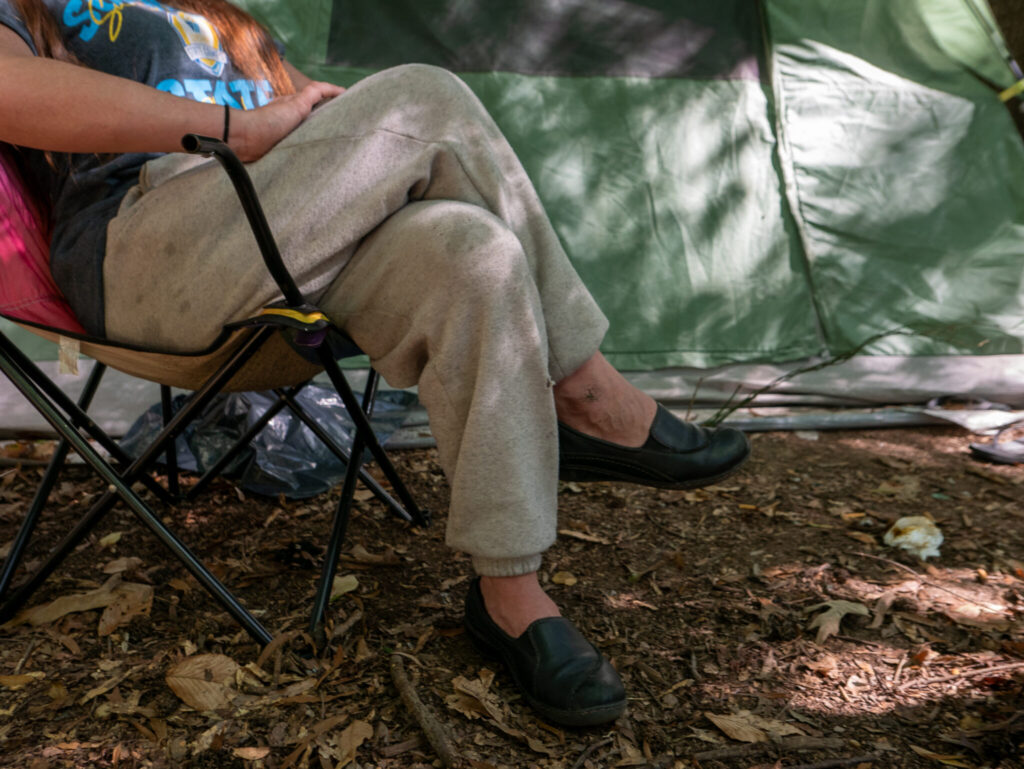
Now, a month and a half later, after police cleared Abraham’s encampment, the couple is living deep in the woods in a remote corner of the District. Abraham is a two-hour bus ride from the programs she frequents, and even further from the neighbors she’d grown to rely on.
“It’s not [just] the social services, it’s not the charitable organization, it’s us together,” Abraham said. “Now we’re in four different quadrants. When we used to be neighbors.”
“And a lot of this is not solving anything,” she added.
For a week in August, people without housing in Washington, D.C. were at the center of Trump’s efforts to consolidate power. Donald Trump labeled them a scourge and used their existence as justification for militarizing the capital and taking control of local law enforcement. At the time, much of the national debate revolved around our democracy and its decay, a debate that has since refocused on troop deployments in Chicago and Portland. But the people targeted were never just political pawns — they were always humans living in the most fragile of circumstances. And, long after the national debate has moved on, they remain haunted by the capital’s new posture toward homelessness.
Street Sense has closely followed six people who were displaced during the takeover. Two of them have chosen to flee D.C. entirely for green space in Virginia. Four have stayed in D.C., including Abraham and her boyfriend. From stairwells to metro stations to the grounds of the Pentagon, they’re all still sleeping outside. All six have lost belongings and suffered exhaustion and physical ailments since their abrupt clearings. None of them are closer to housing.
On Aug. 11, Trump federalized D.C.’s police and deployed the National Guard as well as hundreds of federal agents to the District with the primary goal of reducing crime. During the press conference announcing what the president called a public safety emergency, Trump framed homelessness as a contributor to the city’s crime problem and directed law enforcement to remove tents and, potentially, arrest people for sleeping outside.
Two days after Trump’s announcement, on Aug. 13, D.C. officials began preemptively clearing encampments. The next day, federal law enforcement officers visited Abraham’s encampment at Washington Circle, but did not clear the tents there. Then, four days after the takeover began, the D.C. police, which were under federal control, cleared five separate sites throughout the city. More federally mandated encampment clearings followed in the coming weeks, even as the city ramped up its own schedule of standard encampment clearings. In total, at least 35 encampments have been cleared since then.
Three weeks into the federal takeover, D.C. conducted a census of people sleeping outside, similar to the city’s annual Point-in-Time Count, where teams survey the entire District on foot for people experiencing homelessness. The city found relatively the same number of people — over 750 — sleeping outside as in January. Now, nearly a month later, tents are scarce, but people remain outside.
This August wasn’t the first time Jesse Wall had experienced an encampment clearing — he’d been cleared four times in the last six months. But this was the first time he was forced to move after the president of the United States took a photo of his green and gray tent and posted it to social media, declaring: “The Homeless have to move out, IMMEDIATELY.”
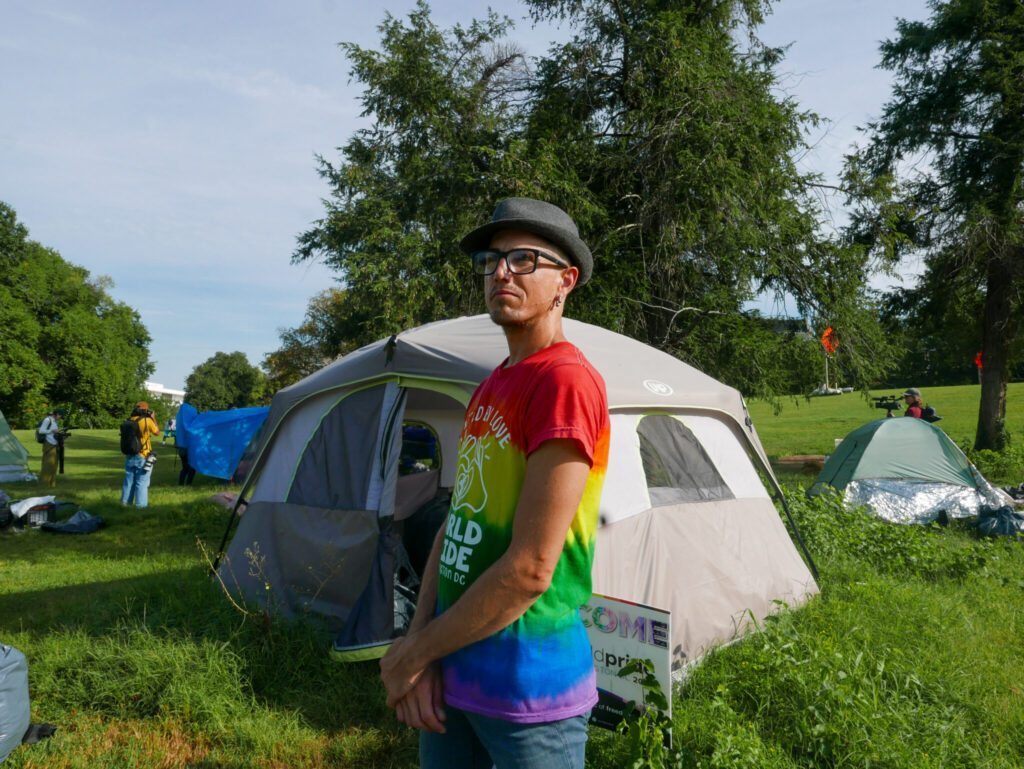
Sitting at a park picnic table in Crystal City, Virginia, the morning light cast shadows over his face, Wall fiddled with the strap on his backpack. He’d risen before 6 a.m. to make the nearly two-hour round-trip journey for breakfast at a familiar meal program in D.C. and now was waiting for the local public library to open.
The city cleared Wall’s encampment on Aug. 14, just days after Trump posted photos of it on Truth Social. The day of the closure, Wall packed up his stuff as news crews descended onto the highway median where he’d been living for the past couple of months. He spent the next day in a hotel paid for by a local mutual aid group, but he couldn’t even rest or enjoy sleeping indoors for a change.
“I had to sit there and be thinking and planning about the next mode for survival, the next place to where I could go. It wasn’t offering any sort of peace or serenity,” he recounted. Wall is also keeping a low profile because of an interaction with the criminal justice system, which he says has contributed to his homelessness and has left him feeling retaliated against.
“It was feeling pushed, feeling forced, feeling like I didn’t count as a person in D.C.,” he said.
Wall significantly consolidated his things so he’d be more mobile in case he had to move again. Among the stuff he misses most are his pillows — it’s hard to get a good night’s sleep without them. After leaving the hotel, he spent a couple of days sleeping on the grounds of the Pentagon, before being told by a local police officer he couldn’t stay there. Now, Wall’s tent is set up in a grassy patch nearby, and he spends most days commuting into D.C. to access meal programs and a queer affirming day center. Hauling his laundry across state lines to the day center is particularly frustrating, he told us.
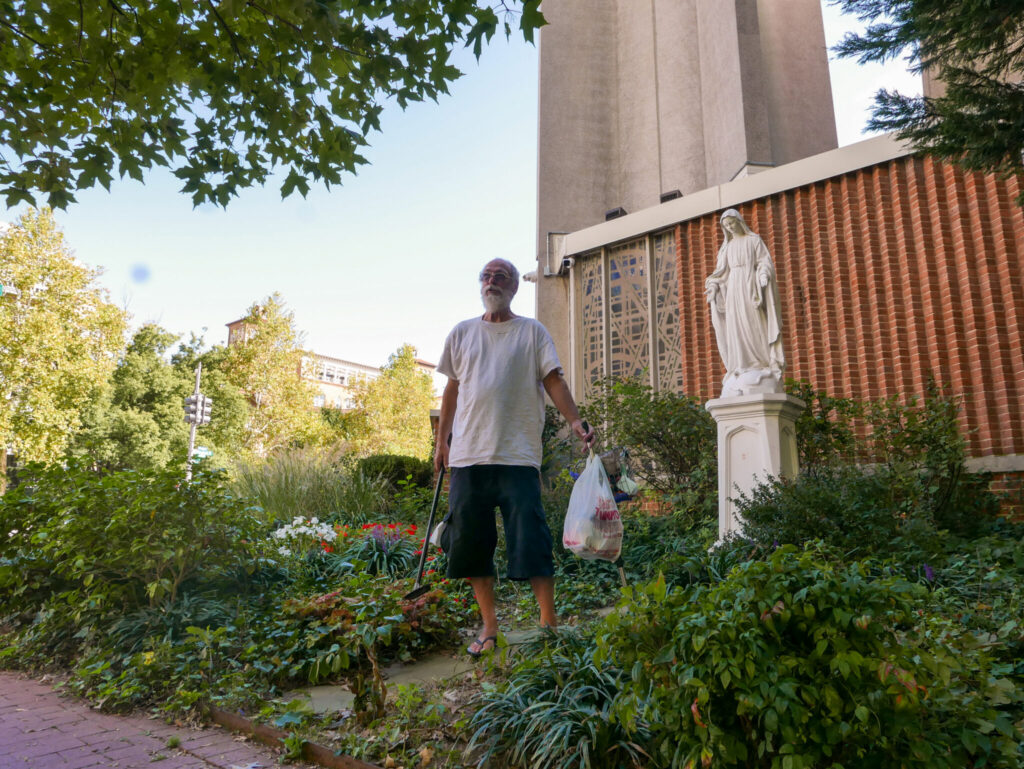
Across the river in D.C., David Beatty, a former neighbor of Wall’s, recounted similar feelings. Beatty is a devout Catholic who attends mass multiple times a week. He’s not only critical of Trump’s approach to homelessness but also thinks his position on immigration isn’t Christian. He’s even devised his own parable to demonstrate that earth, like heaven, should have no quotas on entrants.
“His lack of mercy is not going to — it’s not going to get him to have God show mercy to him,” he told us.
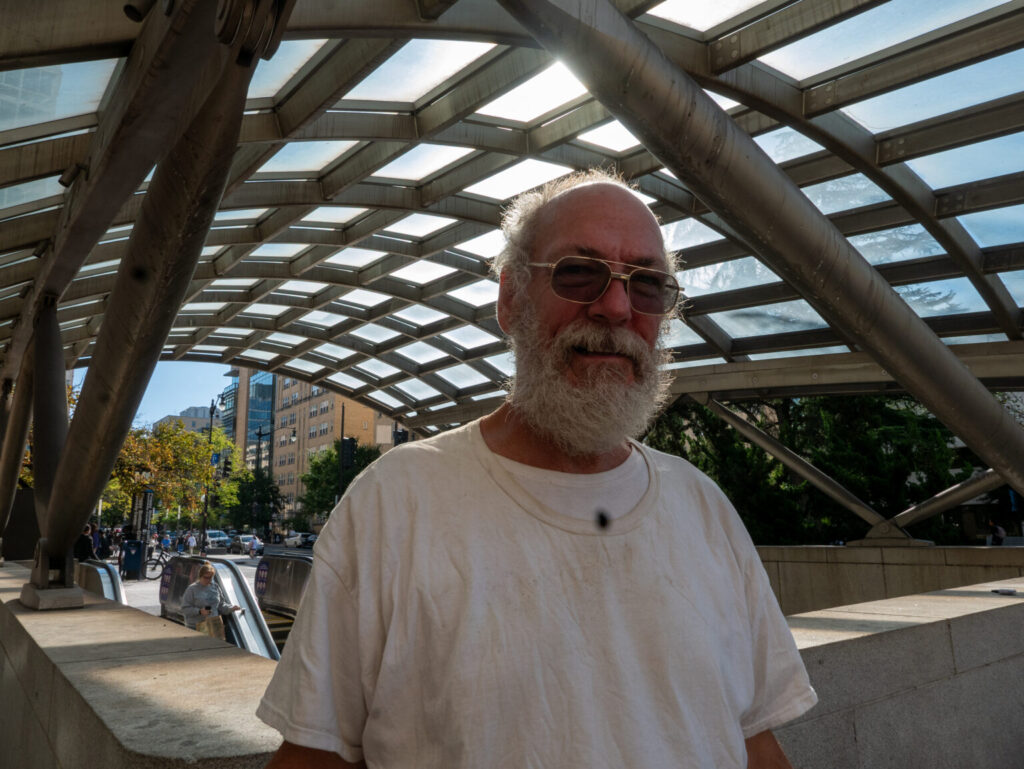
Since the clearing, Beatty has been sleeping outside without shelter. He discarded his tent during the closure and isn’t sure when he’ll put one back up again. For now, he’s content to spend his days sweeping and gardening outside of St. Stephen’s and his nights tucked under an overhang at a nearby metro station.
“It looked like it looked like anywhere you set a tent up around here, they were just coming in, taking it away,” he said. “If you left it, you’d come back in it, it’d be gone.”
That’s exactly what happened to Jeff Padgett.
Earlier this summer, Padgett returned to D.C. after living with his brother in Baltimore and then spending a month in San Diego. Remembering the stress of encampment clearings he’d experienced at Whitehurst Hill last fall, he was wary of sleeping outside in the District again, especially as outreach workers warned there could be stricter enforcement against camping with Trump in office. Instead, Padgett and his two dogs, Puppet and Luna, set up camp across the Key Bridge in a wooded part of Virginia. Padgett would walk the couple of miles into D.C. to stay connected with his caseworker and social services.
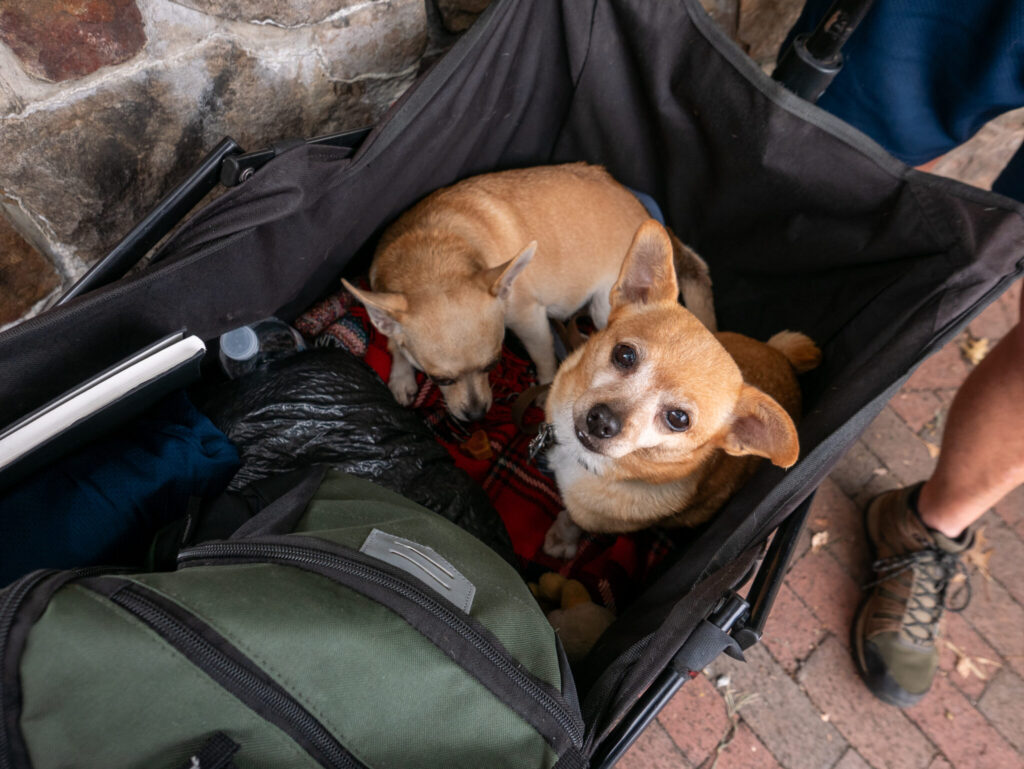
“I think it’s messed up,” he said. “They asked me to leave the District, right? … I pay my taxes. I have a right to be wherever and not be harassed.”
When the federal takeover started, Padgett felt called to step up and speak to the press – feeling safer while sleeping in Virginia. Days after his interview with CNN went live, he came home to nothing.
About five tents remained untouched nearby, but all that was left of Padgett’s belongings was the dust beneath his tent. Trinkets from his Boy Scout days, winter sweaters for the dogs, and $60 worth of food were among his missing belongings. It’s unclear if Park Police took the tent, since Padgett was on federal land, or if it was stolen.
The wet, cold nights triggered Puppet to have three seizures. To take care of his girls, Padgett skipped meals and went days sleeping in the rain with just a sleeping bag to keep them warm and full. Padgett prays daily to help him manage the pain of his third bout of cancer and multiple herniated disks that sleeping on the ground aggravates.
He’s spent two-thirds of his monthly Social Security check to replace what was lost and is worried about how they will last the rest of the month.
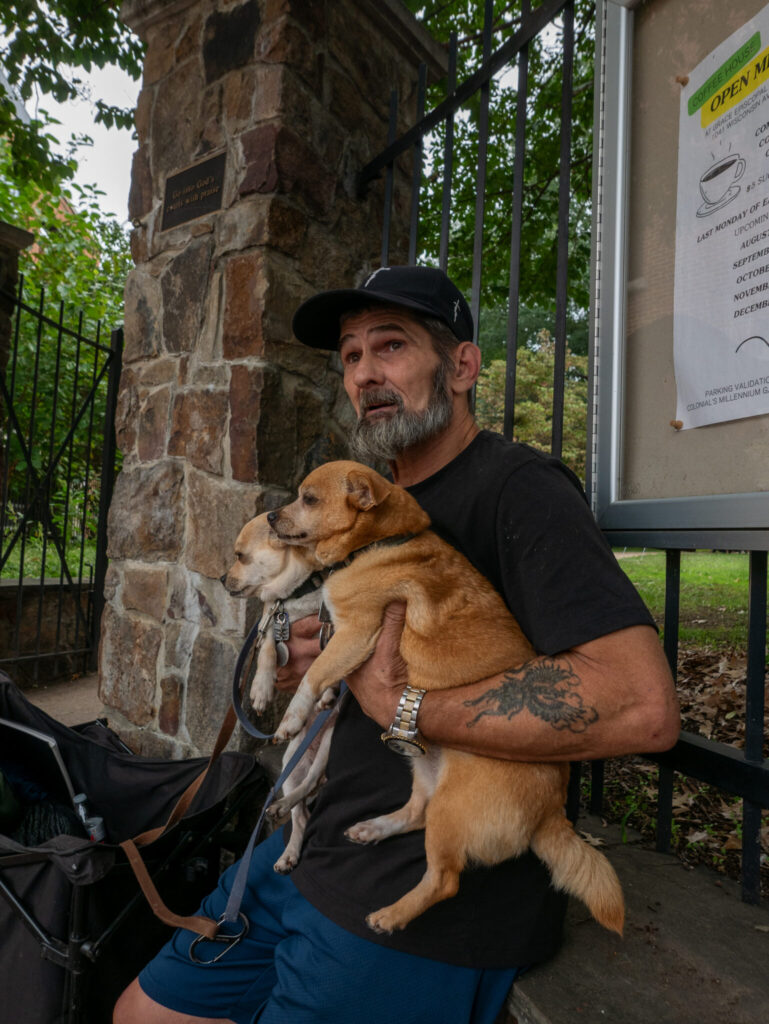
Everyone we spoke to recounted losing or giving up important belongings due to the encampment closures. Beatty abandoned his tent and is now sleeping outside, like Padgett.
Abraham was able to move a lot of her belongings from Washington Circle with the help of local outreach workers. But then, she lost most of them in another clearing about a week after D.C. police first showed up at her tent — also federally mandated. Abraham didn’t know that at the time. She had just come back to her spot after meeting her boyfriend for a few minutes, and all her belongings were gone.
“I was so incensed, so mad, I yelled to the world and walked away. All I was told is that it was thrown out,” Abraham said. Among the things she misses most are her clothes, including a green and white dress with a swirl pattern and a blue and white striped skirt. Now, the clothes she’s left with make her feel like she’s not herself.
“I’m walking around looking like a bum because I’m wearing bum clothes,” Abraham told us. “I used to look like a woman.” These aren’t the only new challenges Abraham has faced since the clearings; she’s acquired a mysterious, slow-to-heal wound on her foot, and somewhere in the process of scouting a new spot and hauling her stuff across the city, she lost her phone.
While Abraham turned to the woods to stay under cover, in the alleys of Georgetown, G and his friend K found shelter from the rain and clearings in a narrow alcove behind a stairwell on private property. G lost his tent and a stash of his belongings during the federally mandated Aug. 15 clearings carried out by local D.C. police, but he was able to save one of his bikes. Over the past year, G’s been no stranger to encampment clearings. He’s lost tools, scooters, and generators during at least eight city encampment clearings. But G continues to wait it out for his housing voucher and keeps “goin’ with the punches.”

While he was offered shelter at a new non-congregate shelter, G turned the spot down because they would only allow him to bring two bags, and he felt he didn’t have time to pack and consolidate. He said he’s been on the housing voucher list for 68 weeks now and just wants to be housed. But delays continue. His most recent apartment inspection failed because the light bulb in the fridge was out.
Wall is also close to moving into housing, after years of waiting, but the recent closures haven’t made the process any easier.
Since his voucher was issued in the spring, Wall’s toured over 20 different apartments. Some haven’t met his criteria, others have refused to rent to him, and still others have failed the city’s inspection. He’s also missed a number of apartment tours because of encampment clearings, including on Aug. 14, when instead of visiting a promising apartment, he spent the day packing and hauling his belongings. Despite the missed opportunity, Wall is lucky — he’s received an extension on his voucher until November.
“I felt, really, kind of almost hopeless,” Wall said, reflecting on the day of the clearing. “I don’t know how to explain the feeling — that was really, like: Why? Why are they doing this? What are you accomplishing by pushing people away that need the services that are [in D.C.], and keeping them from those services and forcing them into situations that may not be safe for them?”
The federal takeover of MPD ended on Sept. 10, but the city continues to schedule and conduct encampment clearings.
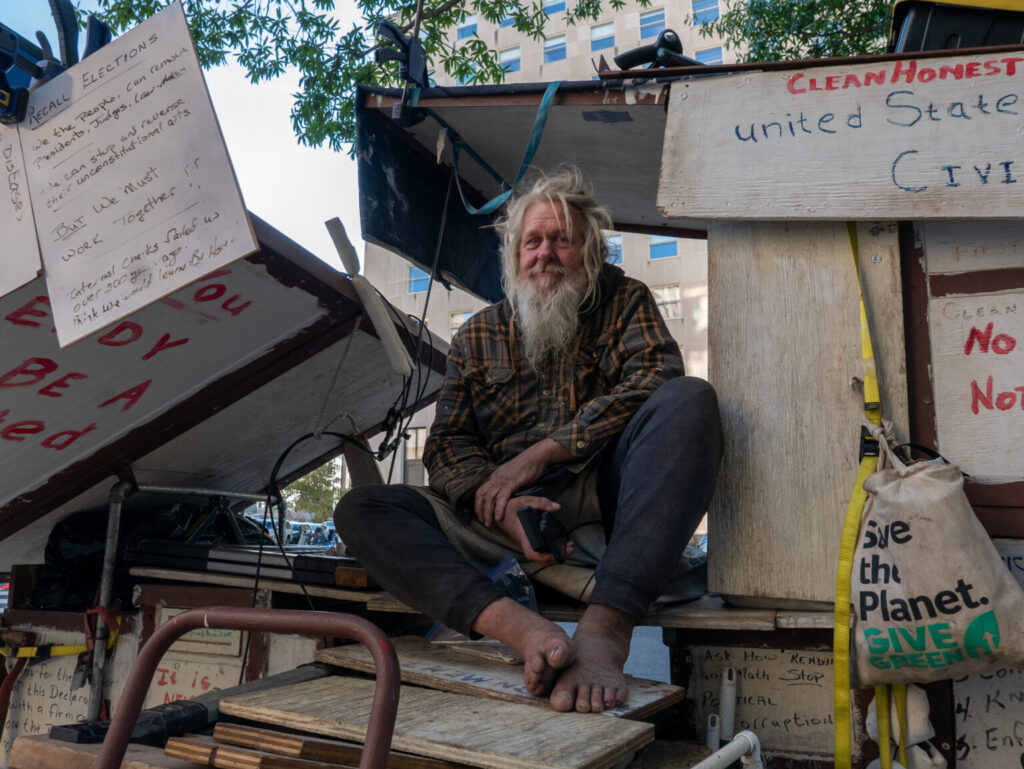
Two days after the end of the takeover, Daniel Kingery and the self-constructed structure he lives in — the human-powered vehicle outside the McPherson Square metro stop — received a notice his encampment would be cleared Oct. 2. The notice came shortly after a woman, who was displaced by the federally mandated Aug. 15 clearing, like G and Abraham, moved her green tent beside Kingery’s vehicle.
When the day of the clearing came, with the exception of a cluster of National Guard officers spectating from the metro entrance, it was a return to D.C.’s typical protocol.
But Kingery refused to move, telling the surrounding city officials and police officers to “cite where in the constitution” they had the power to make him move.
Roughly an hour and a half after the 10 a.m. start time, Kingery was still sitting in the structure when D.C. police received the green light from the D.C. Department of Behavioral Health to remove him on the grounds of bringing him to a hospital for an involuntary psychiatric hold. Five officers surrounded Kingery, grabbed him by his arms and legs, and began pulling him off of the structure. As Kingery fought back, he landed on the sidewalk on his back. The five officers proceeded to pin him, turn him onto his stomach, and cuff his hands behind his back.
Over the next several minutes, Kingery refused to stand up. Officers dragged him at first to a police car and then, after failing to fit him in the backseat, lifted him onto a stretcher.
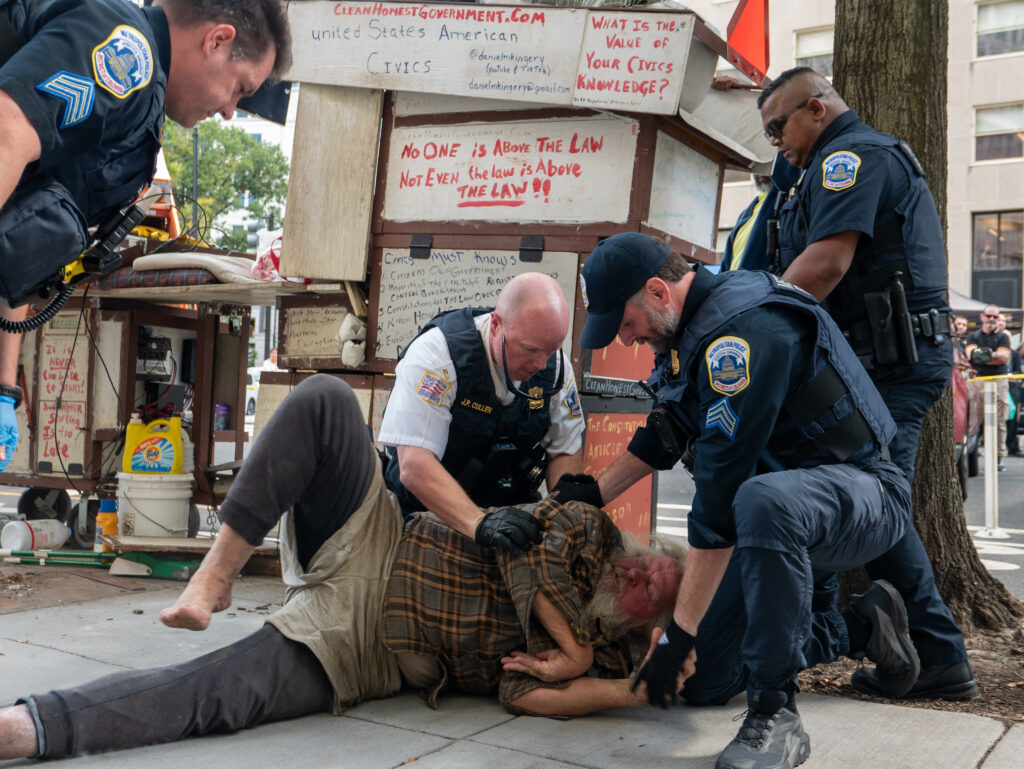
The city’s team then finished their standard encampment protocol by dismantling the human-powered vehicle, piece by piece. Save for the wagon full of bits and tools the National Alliance to End Homelessness and outreach workers were able to save from the dump truck. Everything else was thrown away.
Hours later – just as the sun had begun to set, Kingery stepped out of a taxi at the McPherson Square metro stop, paid for by the hospital after staff had deemed him fit to be released. Thankful he’d worn two layers of clothes, Kingery looked at his now-empty street corner with nothing but the bruises on his back.
Koesler also was part of the two person team running the Live Blog during the first week of the takeover across WordPress and Street Sense Media’s social media accounts.
The blog archive can be found here: https://streetsensemedia.org/article/encampment-clearings-begin-after-trump-orders-federal-takeover-of-mpd/
© Madi Koesler Photos